Teacher evidence across the Gulf and Egypt: what each framework asks for
A short map of the school and teacher frameworks in the UAE, Qatar, Bahrain, Oman, Kuwait and Egypt, and how one evidence habit serves all of them.
One region, many frameworks
Schools across the Gulf and Egypt answer to different regulators, but the questions behind every visit are remarkably similar: what are students achieving, how good is the teaching, and can the school show it?
| Country | Schools are evaluated by | Teachers are measured against |
|---|---|---|
| United Arab Emirates | The UAE School Inspection Framework: six performance standards, used by KHDA in Dubai, ADEK’s Irtiqa’a in Abu Dhabi and the other emirates | The UAE teacher standards behind teacher licensing: conduct, knowledge, practice and growth |
| Qatar | Qatar National School Accreditation: five fields, from the quality of the self-study to resource management | National professional standards for teachers, tied to the teaching licence |
| Bahrain | BQA school reviews: four aspects and ten standards (Schools Review Handbook, 2024) | Staff professional development is judged within the review |
| Oman | The national school performance evaluation system launched in 2024 | The Omani national framework for the teaching profession: knowledge, skills and professional values |
| Kuwait | Ministry follow-up and supervision | The annual performance report (تقرير الكفاية) |
| Egypt | NAQAAE accreditation: two domains and nine areas, including the teacher and the curriculum | The national standards for teachers: planning, strategies and classroom management, subject knowledge, assessment and professionalism |
Frameworks change, and several of these were updated recently. Always work from the edition your regulator currently uses.
What they have in common
Read side by side, these frameworks ask for the same kinds of evidence:
- Planning: lesson plans, unit plans and curriculum maps that show intentions and differentiation.
- Teaching in action: observation records, walkthrough notes and samples of student work.
- Assessment and its use: analysed results, and what the teacher changed because of them.
- Professional growth: training, reflection, goals and the impact on learners.
- Leadership and follow-up: proof that leaders check, give feedback and act on it.
A school that collects these steadily, in one place, is ready for most of the region’s frameworks at once.
How to prepare in practice
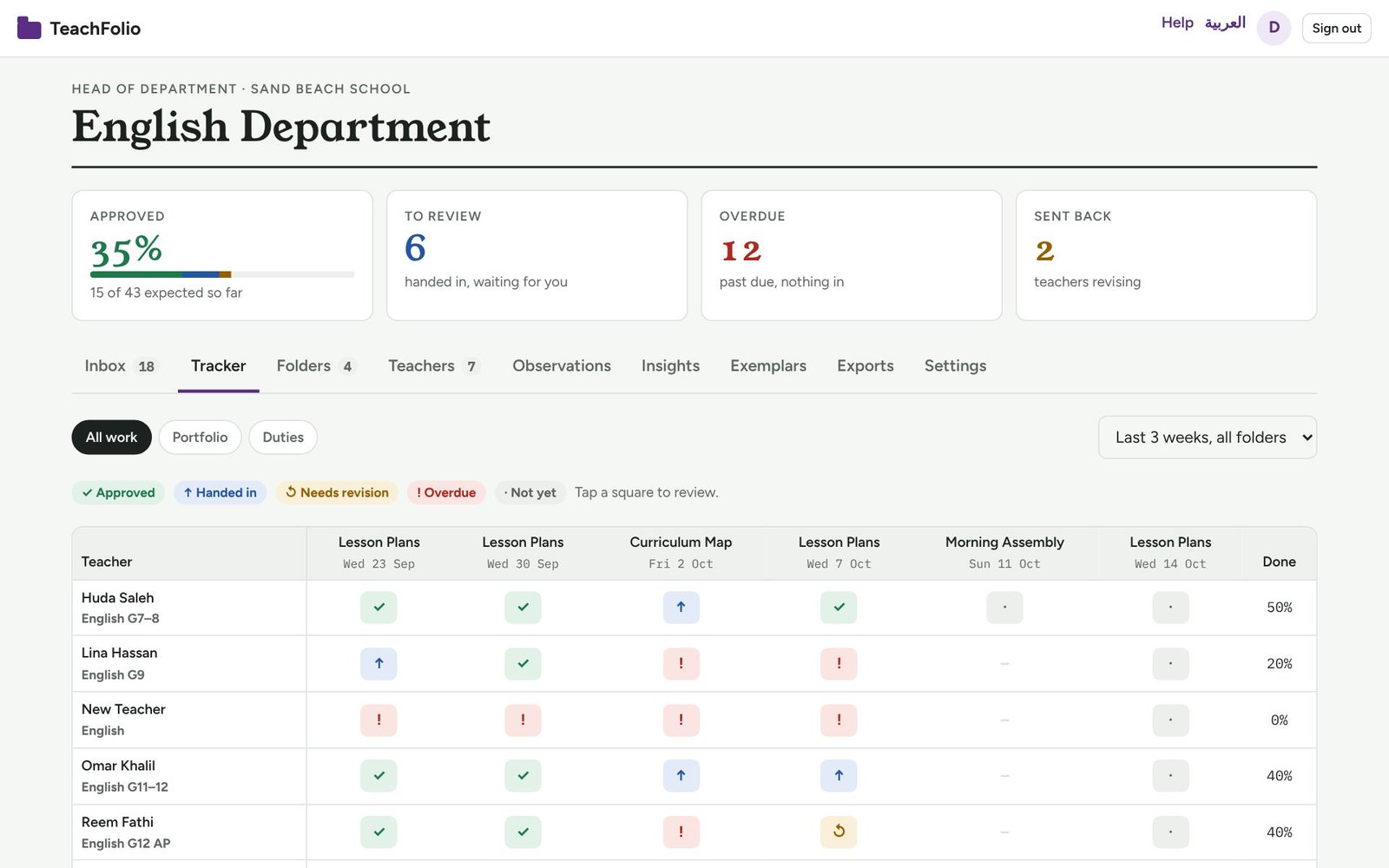
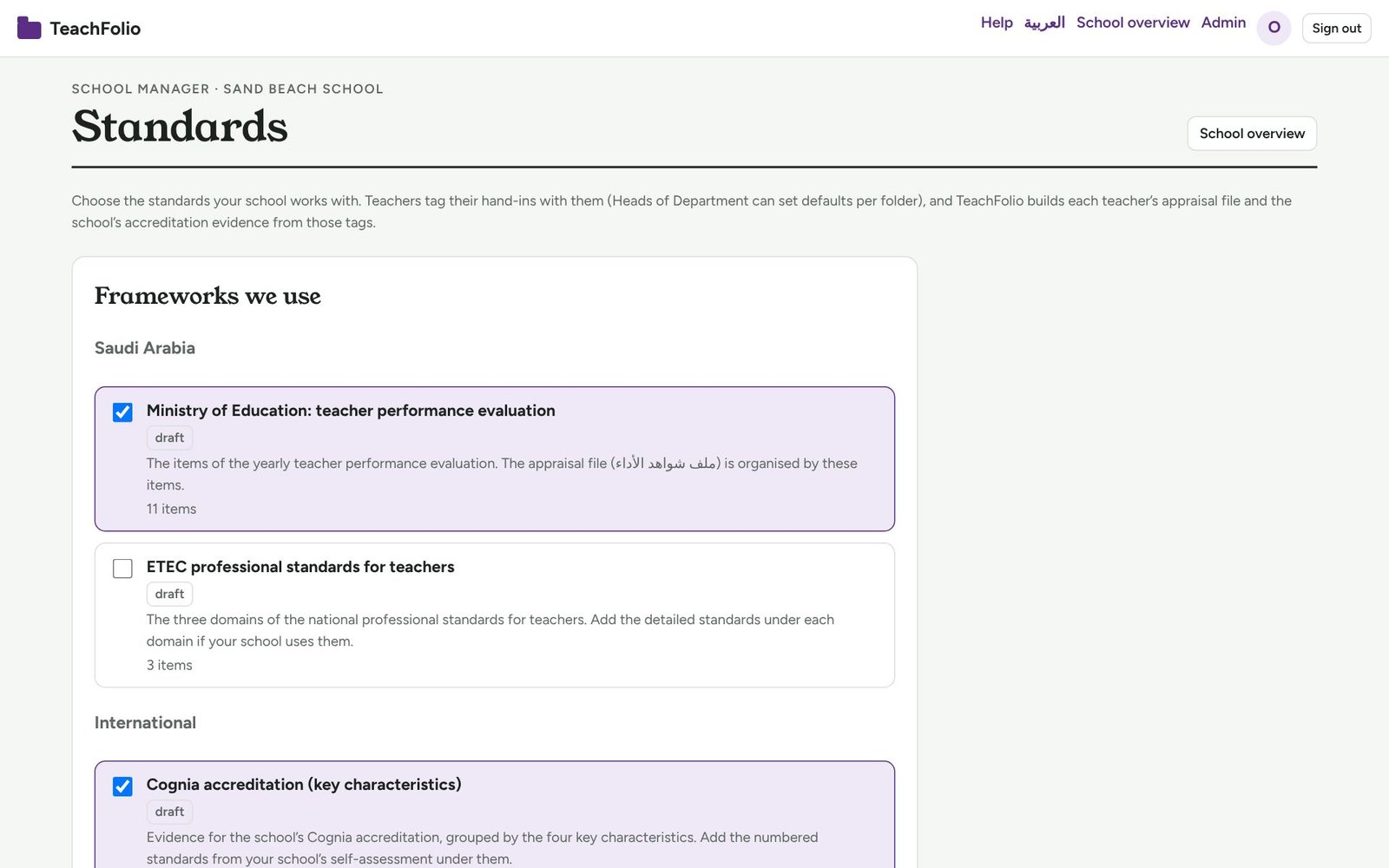
- Choose your frameworks. Usually one for school evaluation and one for teacher standards; international schools often add Cognia or Danielson.
- Map your existing folders. Weekly lesson plans, assessment analyses and observation forms each belong to one or more standards.
- Collect weekly, not yearly. A fixed due date for each folder turns evidence into routine rather than a pre-visit project.
- Review as you go. Approving or returning work with a short comment is itself evidence of leadership follow-up.
- Look for gaps each term. Standards with little evidence in November can still be addressed; in May they cannot.
How TeachFolio helps
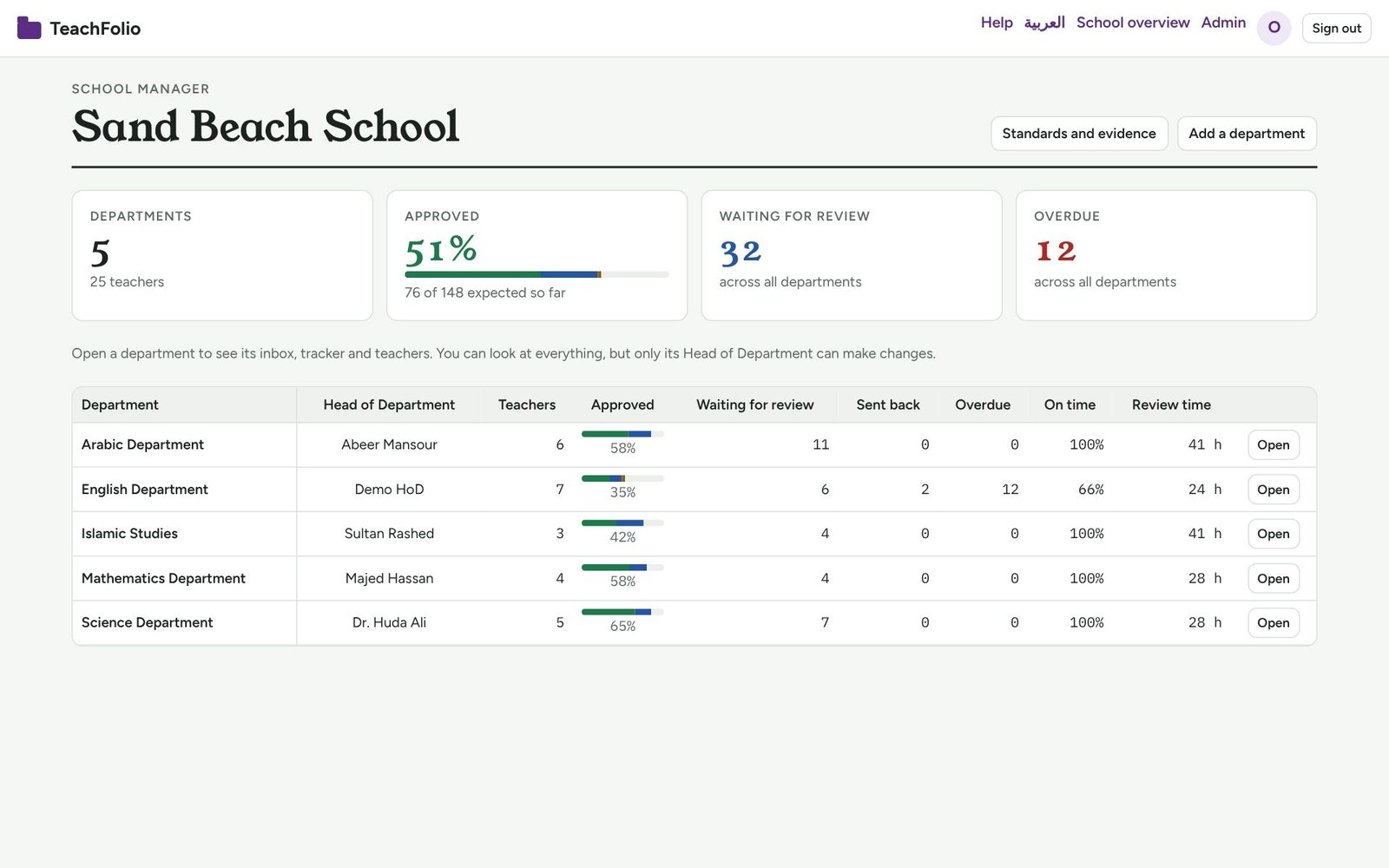
TeachFolio includes the frameworks above as ready-made starting points, alongside the Saudi Ministry evaluation, ETEC, Cognia, Danielson and ISTE. Schools switch on the ones they use, add the indicators of their own edition, and tag evidence once. Each teacher’s file and the school’s evidence pack then build themselves, in Arabic and English.
See how TeachFolio does it with your own folders and standards.